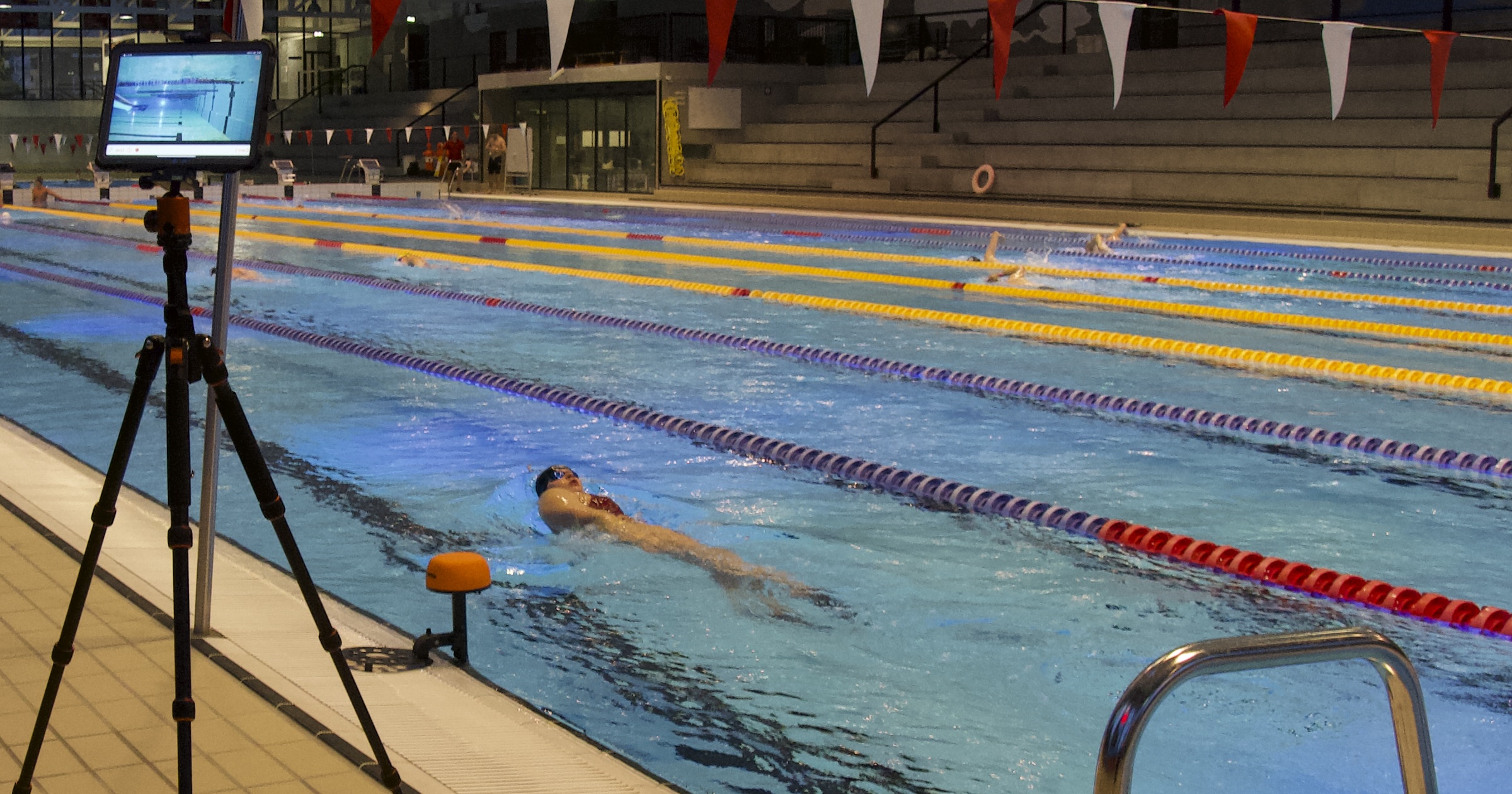
A GoPro shoots 5.3K, and on a pole that can transmit the signal, it will show you a swimmer live, underwater, today. Total cost $1000 max.
What more do you need?
We asked ourselves a related question six years ago when we started Athlee. If GoPro is so great, and the signal poles have been on the market for years, why are so few swimmers getting frequent video feedback from the coaches who own one?
Turns out the camera in itself is not the problem. A GoPro on a pole works beautifully for one coach and one swimmer. It falls apart across a swim squad of twenty swimmers, who need coaching 6 out of 7 days a week, all season.
First things first:
An underwater camera system for swim coaching is not an action camera
An underwater camera system for swim coaching is equipment that films swimmers below the surface and puts the footage on a poolside screen during the session, not after it. It needs to deliver the picture while the swimmer is still in the water. Out of the box, an action camera is a small, durable camera that records for later transfer and viewing. It can be used to film underwater but it is not a camera system for swim coaching.
Here is why.
Why many swim coaches have already tried a GoPro
In June 2024 GoPro announced it had surpassed 50 million cameras sold. And with very good reason. Even though other action cameras, like the ones from DJI, have entered the market, GoPro is still the undisputed leader of the action camera market. Their cameras fit in your pocket and the video quality is amazing. A HERO13 Black shoots 5.3K at 60fps, 4K at 120 and 1080p at 240. A DJI Osmo Action 5 Pro does 4K at 120.
If you are reading this, odds are extremely high that you are a swim coach who already uses, or has used, a GoPro sitting in some enclosure at the end of a camera pole. This lets you easily record a full video where you follow the swimmer for the whole 50 meters. That gives you a perfect video that you can import into your analysis tool. Our coaches do that too. Even with an Athlee camera, they do the full-length recording and import it into the Athlee Coach app for further analysis.
The issue with a GoPro out of the box is of course that you cannot get the live signal from underwater. Water blocks the Wi-Fi and Bluetooth that a GoPro transmits.
How to get a live signal from my GoPro through water
Several companies have found a way to get the signal from a GoPro or another action camera to your phone. All of them share the same principle. They work by attaching a small “signal amplifier unit” close to the back of the GoPro, and then wiring the received signal up to a small transmitter that sends the feed to your phone or iPad. Typically the cable runs through a pole that enables you to move the GoPro around.
You can either build the pole yourself in a few hours with the right parts, or buy a ready-made solution from Seavu, Dunder, CamDo and others. A complete pole with a waterproof case runs a few hundred dollars depending on the vendor and the length you need, and a good action camera on top of that is another few hundred.
In some situations this is an excellent solution.
A GoPro on a pole is an excellent one-to-one setup
With this simple, ingenious setup you have transformed your GoPro into an underwater camera solution for swim coaching for a few hundred dollars instead of the few thousand that an Athlee or any other specialized swim coaching camera costs.
It is very affordable, the video quality is the best in the market, it is easy to move around, and the app from GoPro or DJI comes from a global vendor that updates it all the time. It is a very attractive solution for doing one-to-one sessions with a swimmer. Especially if you are working in an Endless Pool or similar swim spa setup.
Many coaches, including one of my friends, Glenn Mills from GoSwimTV, love this type of solution for their technique sessions because of the video quality and the affordability. So it is really an excellent choice as long as you are working with one swimmer at a time.
That is where the catch is. GoPro-based solutions break when working with a team of 20 swimmers every Tuesday and Thursday afternoon.
A GoPro pole does not scale to a swim team
The main challenge with a GoPro on a pole is that you are attached to the other end of it. You have to hold the pole, watch the screen, start and stop recordings, make sure batteries are charged and so on. If you are in the market for a pole, look at how far away you can move from the signal transmitter with your phone. You will be lucky if it is 5 meters.
So the devil is in the detail: GoPro is an excellent choice for the personal trainer doing a one-to-one session. Very few coaches find it an attractive solution for coaching a whole team with daily, or even monthly, video feedback.
In the past 6 years, since we founded Athlee, I have been visiting and communicating with coaches in more than 30 countries. I have still not met a swim squad that gets daily or weekly feedback from their coach using a GoPro.
That is why I started Athlee as a swim parent.
What daily video feedback looks like with Athlee
Resolution is not what makes it possible for a swimmer to improve their technique. Frequent feedback is.
Athlee is designed to be your video feedback workhorse. The solution that you can set up in less than 60 seconds at every session (Athlee Quick Start Guide). Where you don’t need to plan “a video feedback session”, but where you have it as part of your daily toolbox. The tool that gives you all the details you need, and a shared visual understanding with the swimmer about what they need to fix.
David Marsh, who has coached 49 Olympians and is now Associate Head Coach at Cal:
The key to Athlee is that it is so easy to set up compared to GoPro. It has been a game-changer.
Here you can read about my talk with David Marsh. Or read about Mel Marshall’s perspectives while working with Adam Peaty.
The Athlee Camera has only one button, a built-in Wi-Fi unit, and a battery that runs up to 10 hours. It floats, by the way, if you drop it in. And it streams to Athlee Coach, which is designed for and with swim coaches, and which eight devices can watch at the same time. So the assistant coach with nothing but a phone in her pocket is looking at the same picture you are.
With Athlee Coach you can draw on any recording, measure angles, time a stroke cycle, watch frame by frame, compare to a video of the same swimmer at the last session or a month ago. All in one quick workflow, and move on to the next swimmer in line. You can save the recording, if you need, but as a default a video is a snapshot of what just happened.
Within 5 minutes you can give accurate, detailed feedback to every swimmer in a lane.
And your feedback? You can record that too, including everything you said, measured and pointed to. Easily shared after the session or stored on the swimmer’s profile in the app’s video library.
So a major difference is that GoPro and other action camera apps are designed for general use. The GoPro app has to work for surfers, skiers and vloggers. Athlee Coach only has to work on a pool deck.
Here is a short walk through of some of the core features of Athlee Coach.
But there is something important that we have not talked about yet.
Swimmers watch themselves while you coach someone else
More times than you can count, you have heard “I am already doing that!”, or some variation thereof. And the swimmers mean it. They are not arguing with you. They cannot feel the elbow drop, because water gives them almost nothing to feel it with. A dancer has a mirror. A lifter feels the bar. Your swimmers do not have the same immediate feedback.
This is why you also have the Pool Box that can hold an iPad. So after you have given the swimmers their focus points, they can work in their own loop. Swim the length, get to the wall, watch while the feeling is still in the body. Push off and do it again. Five swimmers working in a lane.
Braden Holloway at NC State on how it works:
We’re doing four different delays, and it helps so much to be able to see it over and over and over and over again. It’s a huge key for the swimmers, and I think that’s the beauty of Athlee. You get great footage, and you do it at a repetitive rate.
With a single camera and two iPads you can work with 5 swimmers in one lane, and have 5 other swimmers working on their own with their focus points in the next lane. Like an extra assistant coach.
Jon Brayne, performance swimming coach at Mount Kelly, on what changed:
We obviously, as coaches, see them swim time and time again, and we end up saying the same thing time and time again, and sometimes it falls on deaf ears. But with the kids being able to see themselves, they were able to implement it from one being soft, second one being better, and then they got more into it.
With Athlee you do not get a camera. You get a new way of working with video feedback. We call it “Swim. Watch. Fix. Repeat.”
Which underwater camera is best for a swim team?
In short: For one-to-one technique work, a GoPro on a signal pole. For a squad training most days of the week, Athlee.
Here is the full comparison.
In our experience - when it comes to teams - the choice is not really between Athlee and a GoPro. It is between daily video feedback and perhaps video feedback once or twice a year.
Matthew Trodden, Depute Head of Swimming at the University of Edinburgh:
It’s been the best bit of kit we have ever bought for impact across the squads!
Swim. Watch. Fix. Repeat.
Thanks for reading!
Thomas